
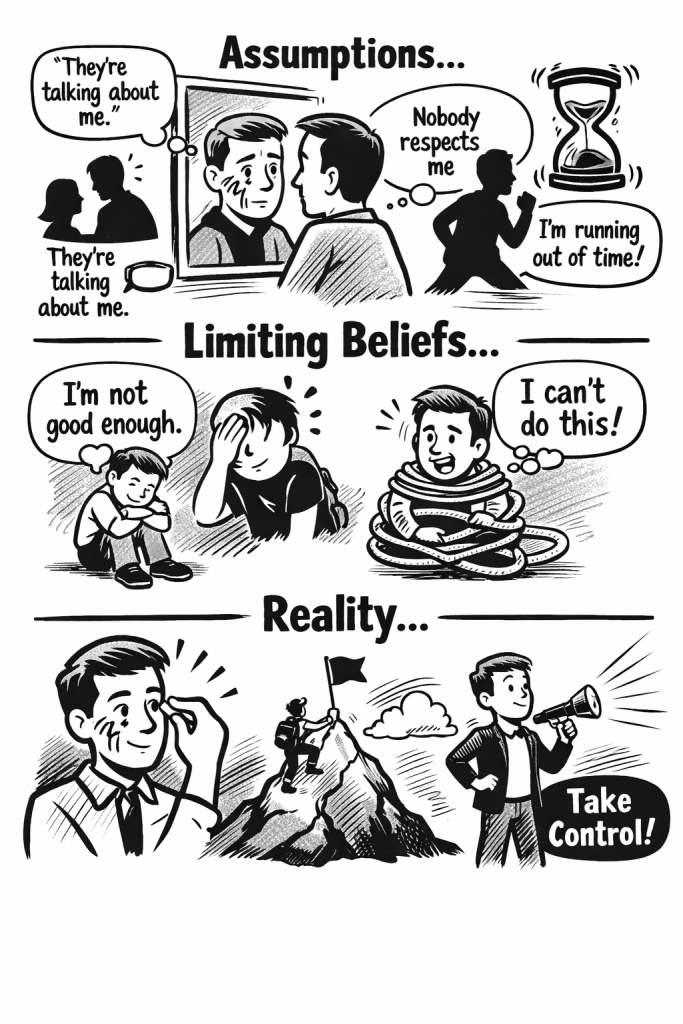
Many leaders aren’t reacting to reality. They’re reacting to a story they’ve been telling themselves for years.
A look. A comment. A silence.
We fill in the blanks—and then lead as if our assumptions are facts.
A study from the 1980s exposes just how powerful (and misleading) our perceptions can be.
It’s called The Dartmouth Scar Experiment. Participants were led to believe they had a temporary visible facial scar that would affect how others treated them. A fake scar was applied to their faces with makeup, then they were shown what they looked like in the mirror.
They were told they would interact with people in public with this fake scar on their face.
As a next step, without the participants knowing, the scar was removed before they interacted with anyone. Then, they went out into public and interacted with people for a period of time.
The results are fascinating. Even without the scar, participants still felt judged and stigmatized, interpreting neutral interactions as negative (Kleck & Strenta, 1980).
The takeaway is striking: our beliefs can distort how we experience reality.
What we assume about ourselves often shapes how we interpret others, whether or not those assumptions are true.
Past failures and challenges have a surprising tendency to resurface in our present thoughts, often hindering our forward movement.
The voice of limiting beliefs yells loudly in our minds.
Here are some examples:
- “I’m not smart enough to succeed”
- “People are always out to get me”
- “I’m behind everyone else”
- “If I slow down, everything will fall apart”
- “I can’t trust myself to make the right decision”
- “My needs are a burden to others”
- “I missed my chance”
- “This is just how I am”
- “I have to do everything if my team is going to succeed”
5 helpful Strategies to Overcome Limiting Beliefs:
- Recognize the Power of Perception: Perceptions shape how we see the world, but our perceptions are just that. Realizing that our perceptions are not necessarily reality is an important first step.
- Cultivate Self-Awareness: This helps recognize my patterns of externalizing blame. It takes intentional thought and time in reflection. Journaling, mindfulness practices & prayer are great ways to cultivate self-awareness.
- Focus on Solutions, Not Problems: When we focus on problems, we reinforce the feeling of powerlessness. Focusing on possible solutions shifts the mind to a proactive mode which then gives a sense of ability to influence outcomes.
- Take Responsibility for Your Choices: We can’t control what happens to us, but we can control how we respond to the situation. Recognize that your choices have an impact on the trajectory of your life, then commit to making decisions moving forward that align with your goals and values.
- Challenge Limiting Beliefs: Limiting beliefs are core assumptions about ourselves and the world that can hinder our progress and keep us feeling stuck. Thoughts like, “I’m not smart enough,” or “This is just how I am,” or “I have to do everything if our team is going to succeed” are examples of limiting beliefs. Many times, a voice from another person I trust can help to raise my awareness and challenge these limiting beliefs so I can move forward.
When we see ourselves as a victim, we tend to twist what people do and what happens in life to fit that narrative, even if it’s not true. To live an intentional life means taking charge of how we react and what we decide to do.
Ditching that limiting victim mindset doesn’t mean pretending life is easy; it means realizing we get to choose how we respond. Taking back that control makes us feel more powerful and gives us a much brighter outlook on things.
Intentional Leadership starts here.
Reference: https://www.psychologytoday.com/us/blog/beyond-school-walls/202410/invisible-scars
 One Intentional Move